
The Economy of Dandys World: How Ichor Mirrors Real-World Monetization
A Currency System Hiding in Plain Sight
Most Dandys World players think of Ichor as just a resource — something you collect during runs and spend on new characters or trinkets. But look closer and you will find something genuinely interesting: the Ichor economy is a near-perfect miniature model of how modern free-to-play games design their monetization systems.
Whether intentional or not, the developers of Dandys World have built an economic loop that mirrors strategies used by some of the most successful games in the world. Understanding it does not just make you a better player — it reveals something fascinating about how game economies work at a fundamental level.
What Is Ichor and How Does It Flow
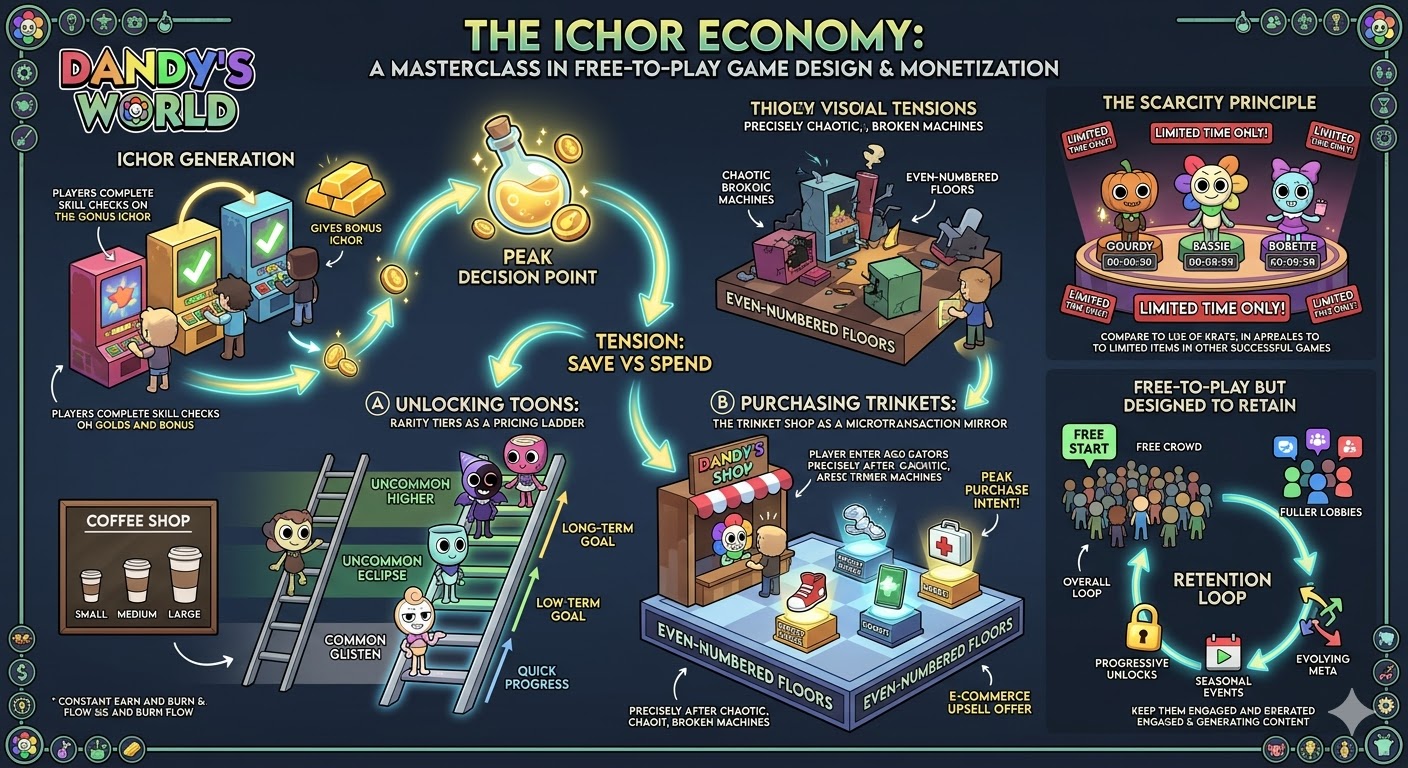
Ichor is the primary currency in Dandys World. Players earn it by completing skill checks on machines during runs, with bonus amounts for hitting gold bars. It is then spent in two main ways — unlocking new Toon characters and purchasing trinkets from Dandy's Shop on even-numbered floors.
This creates a classic earn and burn economic loop. Players are constantly generating Ichor and constantly finding reasons to spend it. The flow never fully stops because there is always either a new character to unlock or a trinket that could save your current run.
What makes this loop effective is the tension it creates around spending decisions. Do you spend your Ichor on a powerful trinket that helps you survive the current floor, or do you save it toward unlocking a better character for future runs? This is not an accident — it is deliberate economic design.
The Scarcity Principle at Work
One of the most fundamental concepts in economics is scarcity — when a resource is limited, people assign it higher value and make more careful decisions about how to use it.
Dandys World applies scarcity brilliantly through its Event characters. Toons like Gourdy, Bassie, and Bobette are only available during limited seasonal events. When they are gone, they are gone — until the event potentially returns. This creates urgency around spending Ichor to unlock them before the window closes.
This is identical to the limited-time item strategy used by games generating billions in revenue annually. The scarcity is artificial — there is no technical reason these characters could not be available permanently — but the psychological effect on player behavior is very real.
Rarity Tiers as a Pricing Ladder
Dandys World organizes its characters into four rarity tiers: Main, Common, Uncommon, and Event. Each tier requires progressively more Ichor to unlock.
This is a pricing ladder — a business concept where products are offered at multiple price points to capture spending from customers across different levels of willingness to pay.
In traditional business, a coffee shop does this with small, medium, and large sizes. In Dandys World, the developers do it with character rarity. A new player can unlock Common characters like Glisten and Finn relatively quickly, feeling a sense of progress. Unlocking Uncommon characters like Eclipse or Cosmo takes significantly more investment, giving experienced players a longer goal to work toward.
The genius of this system is that every player — regardless of how much time they have invested — always has a meaningful next target to work toward. Nobody ever feels like they have nothing left to earn.
The Trinket Shop as a Microtransaction Mirror
Dandy's Shop appearing on even-numbered floors is one of the most carefully designed elements of the entire game from an economic perspective.
Consider the timing. You have just survived several dangerous floors. You have Ichor saved up. You are now standing in a safe shop environment with a clear menu of items that could genuinely help you survive the next floor. The Speedy Shoes could save your life. The Medkit could bring back a struggling teammate.
This is the moment of peak purchase intent — and the developers place the shop precisely there. In real-world e-commerce, this mirrors the strategy of showing upsell offers at checkout rather than at the beginning of the shopping experience. You are most likely to spend when you are already engaged, already invested, and already thinking about what comes next.
Free to Play but Designed to Retain
Dandys World follows a fully free-to-play model — everything is earnable through gameplay with no real-money purchases required. This is actually a sophisticated business decision rather than pure generosity.
Free-to-play maximizes the player base, which maximizes the social network effect. A game that costs money to try has a much smaller audience than one anyone can jump into instantly. A larger player base means fuller lobbies, faster matchmaking, more community content, and stronger word-of-mouth growth.
The retention strategy replaces the upfront purchase model entirely. Instead of charging once at the door, Dandys World keeps players engaged through progressive unlocks, seasonal events, and an evolving meta that rewards continued play. Long-term engaged players become community advocates, content creators, and the foundation of a self-sustaining ecosystem.
This is exactly the model that transformed the gaming industry over the past decade, and Dandys World executes it at the Roblox scale with impressive effectiveness.
What Other Developers Can Learn
The Ichor economy succeeds because it respects player intelligence while still applying proven economic principles. Players always feel like their time investment is rewarded. Spending decisions feel meaningful rather than forced. The progression system has enough depth that there is always something worth working toward.
The key lessons any game developer can take from it are straightforward. First, design your currency flow so that earning and spending happen at roughly similar rates — players who accumulate too much lose the feeling of scarcity, and players who can never save enough lose the feeling of progress. Second, place your spending moments at peaks of engagement rather than at the beginning of the experience. Third, use rarity and limited availability to create urgency without making the base experience feel paywalled.
Dandys World gets all three of these right, which is a significant reason why its player base continues to grow rather than plateau.
Final Thoughts
Next time you are deciding whether to spend your Ichor on Speedy Shoes or save it toward unlocking Eclipse, you are participating in an economic system far more carefully designed than it might appear. The Dandys World economy is a masterclass in free-to-play game design — one that real businesses and developers can learn from just as much as players can.
Understanding the economy also makes you a better player. Knowing why the shop appears when it does, and why Event characters feel so urgent, helps you make cooler-headed spending decisions during the heat of a run.